
The Next Evolution of Index Investing
Broad-market index funds have been one of the greatest financial innovations of the past half-century.
At Open Window, we've celebrated them for decades. Funds like Vanguard Total Stock Market ETF (VTI), Vanguard Total International Stock ETF (VXUS), and Dimensional World Equity ETF (DFAW) reflect the investment philosophy we continue to believe in today.
If we're not managing your life savings, here is what we suggest in our absence.
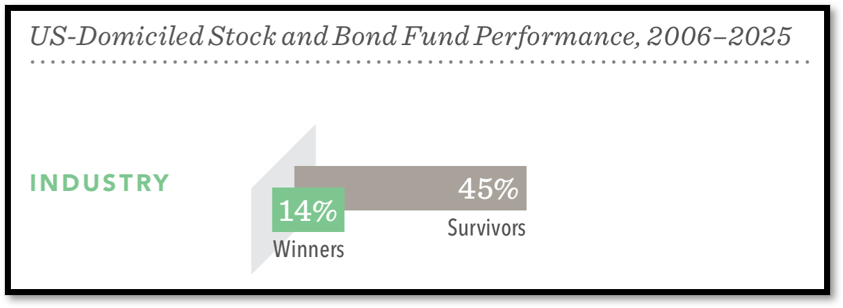
Compared with the high-cost stock-picking strategies that once dominated investing, low-cost index investing has dramatically improved outcomes for millions of investors. The evidence is overwhelming. Among professional investment managers, only about 14% have both survived and outperformed their benchmark over the past 20 years.
But "better than stock picking" doesn't necessarily mean "as efficient as possible."
There is an important difference between owning the world's great businesses inexpensively and owning them efficiently.
It's similar to taking the interstate on a cross-country trip. Both travelers choose the right route and arrive at the same destination. One simply encounters fewer unnecessary slowdowns along the way.
The Hidden Costs of Indexing
Creating and managing index funds requires following predetermined rules. While those rules provide consistency and transparency, they can also create hidden costs that leave money on the table. Traditional index funds still rely on rules that determine what to own, when securities enter or leave the index, and how portfolios are rebalanced.
Every index provider must establish rules governing:
- Which companies belong in the index?
- When should additions and deletions occur?
- How should reconstitutions be handled?
Those decisions create trading activity. That activity can introduce costs that never appear in a fund's expense ratio. When billions of dollars are forced to buy and sell the same securities on the same day, prices can move against investors, particularly in less-liquid parts of the market. These costs are largely invisible because they don't appear as management fees. Yet they can meaningfully affect long-term returns.
Research summarized by ETF.com has documented meaningful price pressure surrounding index additions and deletions, particularly among smaller and less-liquid companies. When an index fund has no choice but to trade on a predetermined schedule, other market participants know exactly what it must buy and sell. That predictability can create unnecessary costs, particularly in smaller and less-liquid securities.
The table below estimates the annual performance drag of traditional indexing for a tax-exempt investor compared with a more flexible, evidence-based implementation approach similar to the one Open Window employs. A basis point (bp) equals one one-hundredth of one percent. One hundred basis points equals 1.00%.
| Asset Class | Estimated Annual Cost Drag |
| U.S. Large Caps | 5–10 bps |
| U.S. All Caps | 5–25 bps |
| Developed International | 5–25 bps |
| Emerging Markets | 10–30 bps |
| Small Caps | 100–200 bps |
At first glance, these numbers seem trivial. Investing, however, is a discipline where tiny annual advantages can compound into meaningful wealth over decades.
Fortunately, many of these costs can be reduced through more flexible portfolio implementation. The goal isn't to own different companies than the index. It's to own many of the same companies more thoughtfully. Unlike trying to predict the next hot stock or sector, reducing unnecessary implementation costs doesn't require making market forecasts.
What might that be worth?
For a $5 million portfolio:
- 25 basis points represents roughly $12,500 annually.
- 50 basis points represents roughly $25,000 annually.
None of these inefficiencies change our enthusiasm for index investing. We believe it remains one of the greatest innovations in modern investing. It simply means there is still room to improve how index-like portfolios are implemented.
How Open Window Invests
At Open Window, we aren't trying to identify the next Nvidia or predict next year's winning sector.
Instead, we build portfolios grounded in decades of academic research, broad diversification, disciplined implementation, and thoughtful trading practices.
Great ideas don't stop evolving simply because they're already successful.
We've believed in evidence-based investing since long before index funds became mainstream, and our investment process has continued to evolve alongside the research. Rather than attempting to outperform the market through prediction, our objective is to capture as much of the market's long-term return as possible while reducing unnecessary implementation costs. A more flexible, evidence-based approach allows us to maintain broad market exposure while using patient trading techniques designed to reduce market impact.
Will better implementation alone transform your financial future? Probably not. But if thoughtful implementation can modestly improve expected returns while simultaneously reducing unnecessary costs, those incremental gains have the potential to compound over a lifetime.
Investment implementation is only one component of comprehensive financial planning. When it's combined with disciplined rebalancing, tax-aware decisions, guidance during difficult markets, retirement income planning, estate planning, and personalized advice, the cumulative value can become far greater than the sum of its parts.
If we can help apply the science of investing to your life, reach out anytime at (775) 827-0670 or schedule a Quick Connection time at www.openwindow.com/connection.
Schedule a Quick Connection time here
Footnotes:
Past performance is no guarantee of future results. Indices are not available for direct investment. Index performance does not reflect the expenses associated with the management of an actual portfolio. Diversification does not eliminate the risk of market loss. There is no guarantee investment strategies will be successful.
This information is for illustrative purposes only.
- "Estimated Annual Cost Drag" provided by Dimensional Fund Advisors. U.S. Large Caps versus the Russell 1000 Index. U.S. All Caps versus the Russell 3000 Index. Developed International versus the MSCI World ex USA IMI Index. Emerging Markets versus the MSCI Emerging Markets IMI Index. Small Caps versus the Russell 2000 Index.
- "US-Domiciled Stock and Bond Fund Performance 2006-2025" provided by Dimensional Fund Advisors. The 20-year sample includes funds at the beginning of the 20-year period ending December 31, 2025. Each fund is evaluated relative to its primary prospectus benchmark. Survivors are funds that had returns for every month in the sample period. Winners are funds that survived and outperformed their benchmark over the period. Where the full series of primary prospectus benchmark returns is unavailable, non-Dimensional funds are instead evaluated relative to their Morningstar category index.