

What Happens to Your Pet If Something Happens to You?
A bond with a pet runs deep. They celebrate with us, comfort us when we need it most, and become part of the rhythm of our lives.
They are family.
Yet for all the love we share with our pets, many of us have done very little to formally protect them if we are no longer able to care for them.
It’s understandable. Estate planning can already feel like quite the undertaking. Adding “What happens to the bird?” may seem like just one more thing to worry about. But without some basic written instructions, your pet’s future can become uncertain.
Fortunately, pet planning doesn’t have to be complicated. Like our relationships with our pets, it simply needs to exist to be effective.
The Legal Reality: Pets Are Property
To us, pets are family.
To the law, pets are property.
Under current law, pets are generally treated as personal property. This is no different than your car, your furniture, or your home. We might not think that, but that distinction still matters enormously for estate planning because your pet cannot inherit under your will. Your pet cannot inherit a bank account. Instead, your estate plan needs to identify the people or legal arrangements responsible for your pet and, when appropriate, provide resources for the pet’s care.
Without specific instructions, decisions about your pet may ultimately be governed by your estate documents and applicable state law, with no guarantee that the outcome will match what you would have wanted.
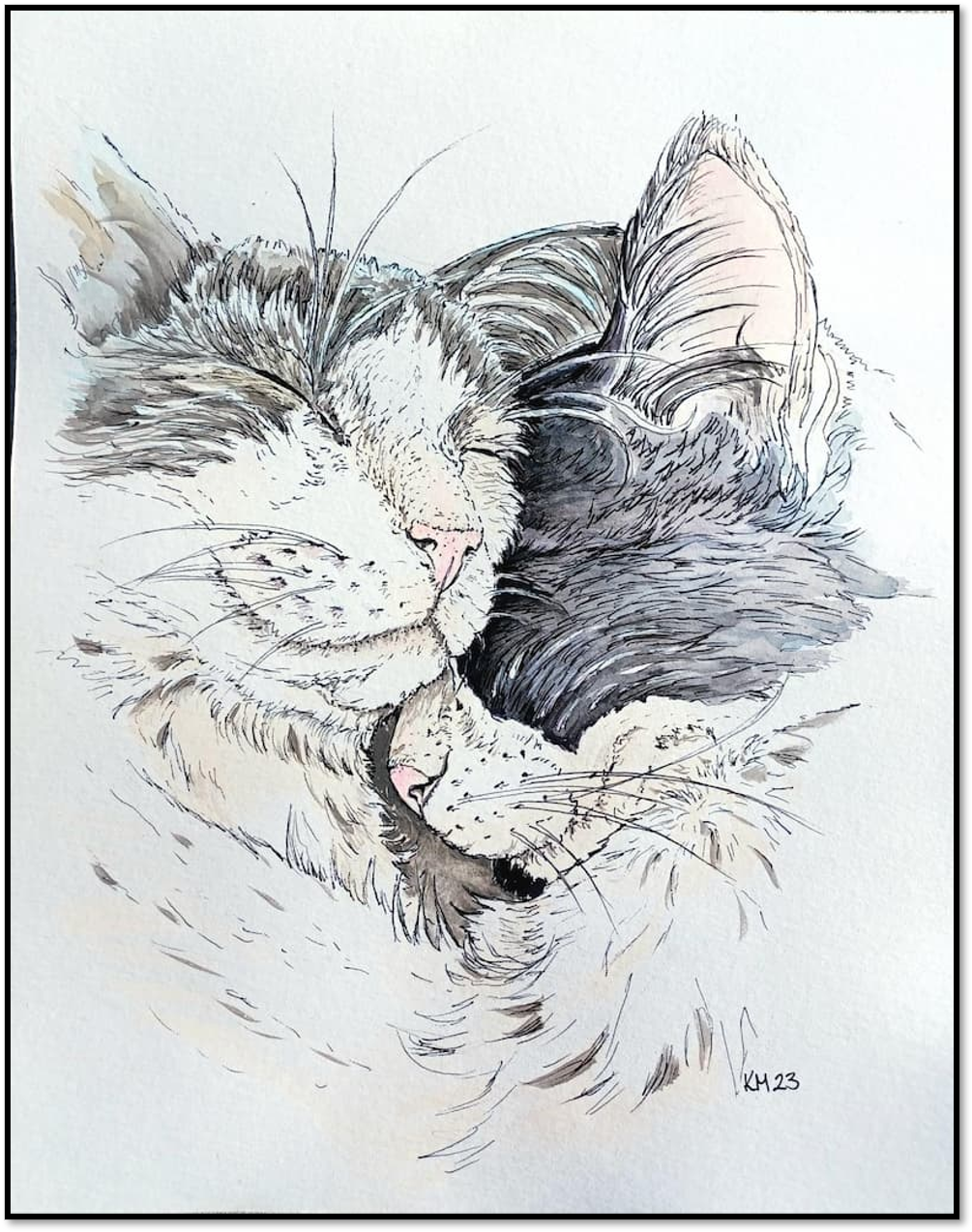
(Illustration by Katy Mikel, 2023)
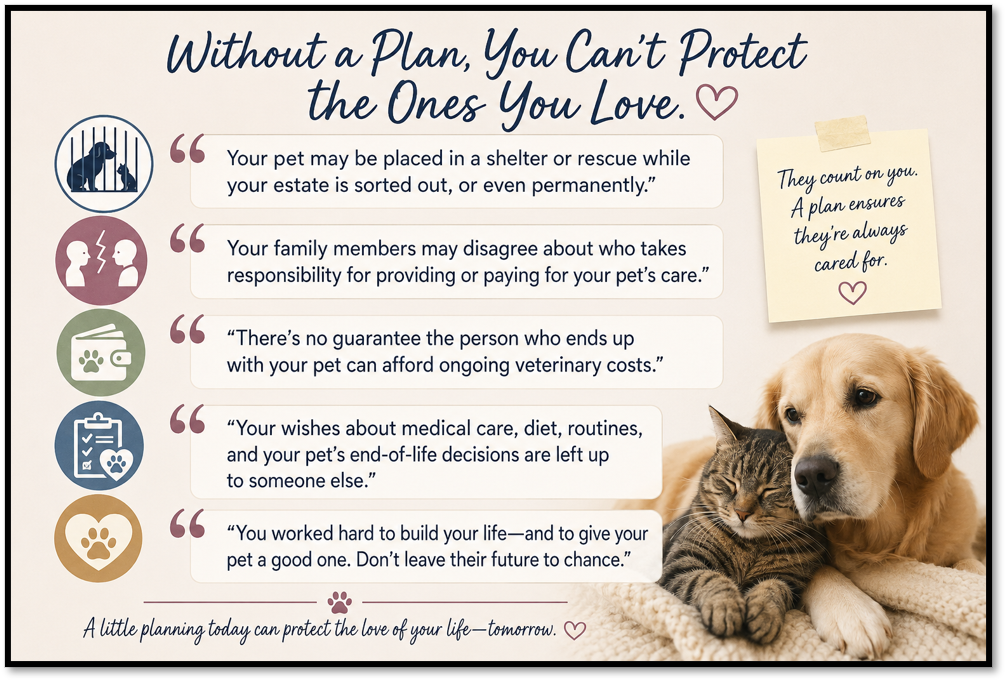
Without a Plan, You Can't Protect the Ones You Love
Every pet owner should consider having a Pet Plan.
A loving verbal promise from a family member—“Don’t worry, I’ll take care of her”—may be sincere, but it is not a substitute for a workable plan.
Plus, life changes. Circumstances change. The person who is willing and able to care for your pet today may not be in the same position five or ten years from now.
If you die without a Pet Plan, your pet could temporarily (or even permanently) end up in a shelter or rescue while your estate is sorted out. Family members may disagree about who should take responsibility. The person who ultimately takes your pet may not have the financial resources to provide the level of care you intended. Your wishes regarding veterinary treatment, diet, medications, routines, living arrangements, and end-of-life decisions may also be unknown.
And this isn't only about what happens when you die. A hospitalization, accident, medical emergency, or period of incapacity can suddenly leave your pet without its usual caregiver just as forcefully. Even a temporary disruption can create a serious problem when no one knows who has authority to step in.
Three Planning Tools To Consider
These three planning tools can help ensure your companion is cared for according to your wishes.
Planning can be particularly important for people who live alone, seniors, owners of multiple animals, owners of exotic or long-lived animals, and anyone whose pet has significant medical or behavioral needs.
1. A Will with Pet Provisions
Your will can identify the person you would like to receive and care for your pet. You may also choose to leave that person additional money with the expectation that it will help cover the cost of care.
For a relatively simple situation, perhaps one pet, a trusted caregiver, and modest anticipated expenses, this can be a useful starting point.
But a will also has limitations.
A will generally does not become operative until death, so it does little to address temporary or long-term incapacity. The administration of an estate can also take time. And simply leaving money to a caregiver may not create an ongoing mechanism to ensure those funds are used for your pet as you intended.
That is why a will provision is often best considered as one part of a broader Pet Plan.
2. A Pet Protection Agreement
A Pet Protection Agreement is a written agreement between you and a designated caregiver.
Think of it as a care manual with legal structure behind it. It may not provide all the protections of a properly drafted pet trust, but it can be a meaningful step beyond an informal handshake or verbal promise.
A well-designed agreement may address:
- Your primary and backup caregivers
- Feeding schedules and dietary requirements
- Medications and medical needs
- Daily routines and exercise
- Behavioral considerations
- Veterinary contacts and medical history
- Grooming, boarding, and other care preferences
- Reimbursement of expenses
- Temporary custody and emergency arrangements
This kind of planning can be especially valuable during incapacity because a will generally addresses what happens after death, not who should step in during an emergency while you are still living.
Your plan should also make it easy for others to determine whom to contact and who is authorized to care for your animals. Depending on the circumstances and applicable law, first responders or other officials may not be able to simply turn your pet over to a neighbor or family member based solely on an assumption about your wishes.
Written instructions can make a difficult situation much clearer.
As another example of the power of written instructions, does your home have a pet alert window sticker?
Pet Alert Window Stickers |
Does your home you have a pet alert window sticker? Pet alert stickers can help notify first responders that animals may be inside your home during an emergency. 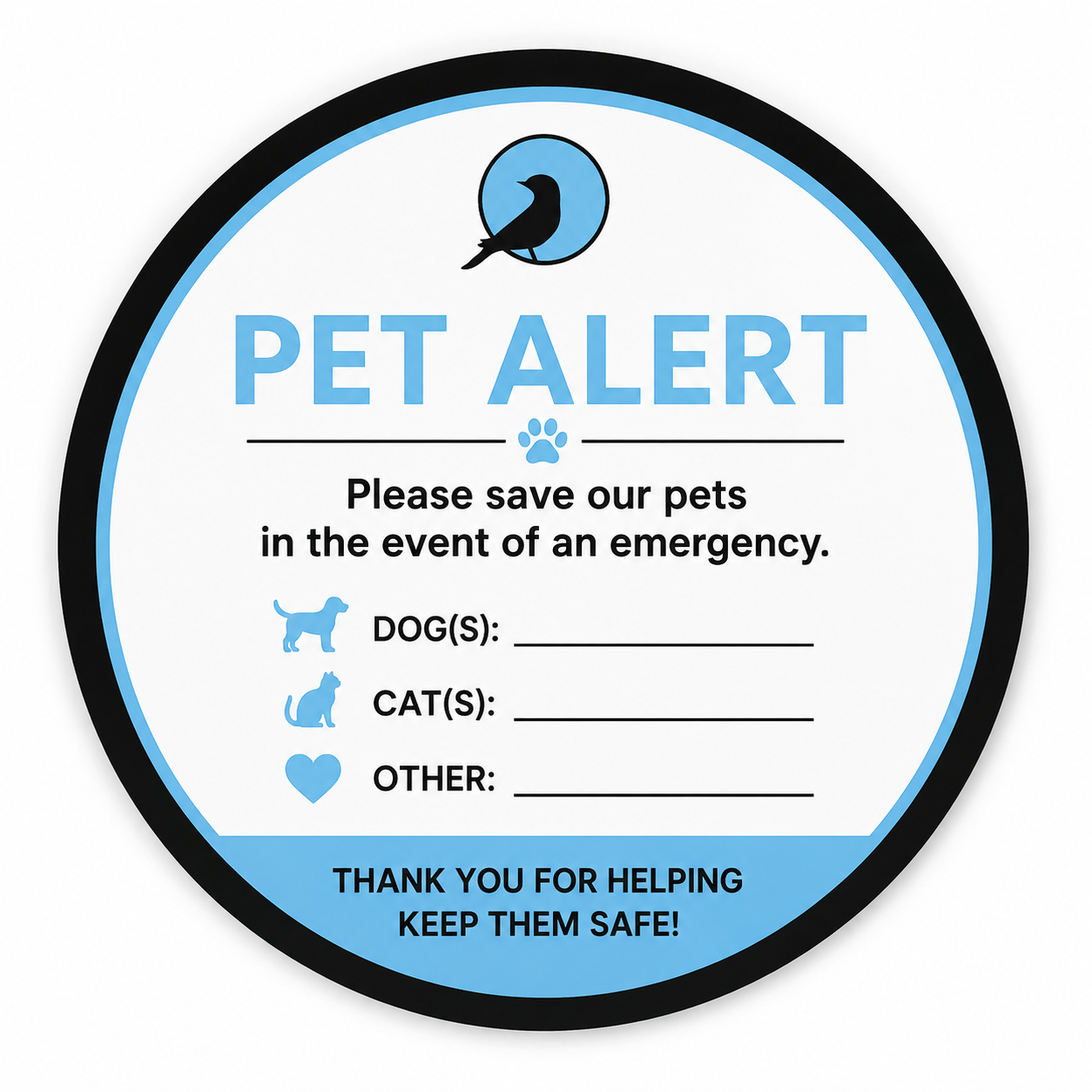 Respond to this article with the word “Pet” (bonus points if you share what kind of pet you have and their name) and we'll send you one free!
|
3. A Pet Trust: The Gold Standard
For pet owners who want greater control, accountability, and financial protection, a pet trust can offer a more complete solution.
A pet trust is a legal arrangement that provides specific instructions and holds specific assets for the benefit of your pet(s).
Depending on how it is structured and the law in your state, the trust can address everything from food and veterinary care to living arrangements, caregivers, medical decisions, and end-of-life preferences. It can also specify what should happen to any money remaining after the last covered pet dies.
Several people can play important roles in a pet trust:
- A named trustee manages the money and makes distributions according to the terms of the trust.
- A named caregiver provides the pet’s day-to-day care. The caregiver and trustee may be the same person, although separating the roles can provide additional accountability.
- A trust protector, trust monitor, or other designated person can help oversee whether your instructions are being followed.
When these roles are separated, the structure can create a natural system of checks and balances: the caregiver looks after your pet, the trustee manages the money, and another person may provide oversight when needed.
The goal isn't necessarily to leave your pet a fortune. It is to estimate your pet’s realistic needs and provide enough resources to meet them.
Some costs to estimate include items like veterinary care (routine, emergency, specialty), food, supplies, grooming, boarding, and end-of-life expenses. The expenses can vary depending on your location, the animal's size, and your standards for care. For more exotic animals like a horse, a macaw, or a reptile with a multi-decade life expectancy, the math will look different.
Funding: How Much Should You Plan For?
As a rough illustration, suppose ongoing care costs approximately:
- Cat: $1,500 yearly
- Dog: $2,500 yearly
- Horse: $12,000 yearly
A pet living another 12 years could require approximately:
- Cat: $18,000+
- Dog: $30,000+
- Horse: $144,000+
Actual costs vary widely depending on the animal, health needs, and level of care. Plus, there may be unusually expensive years involving illness, surgery, specialty treatment, boarding, or other unexpected needs.
The point isn't that every pet owner should set aside a particular dollar amount. It's that a pet's lifetime cost can be significant, and thinking about that cost in advance can help create a more realistic plan.
These figures are provided for illustrative planning purposes only. Actual expenses vary significantly by region, species, breed, age, health, and desired level of care. When estimating future needs, consider current veterinary and pet-care costs applicable to your individual circumstances. Figures are based on published data from the American Pet Products Association (APPA), the American Veterinary Medical Association (AVMA), ASPCA pet care cost estimates, the American Association of Equine Practitioners (AAEP), and species-specific guidance from the Association of Avian Veterinarians (AAV), adjusted to reflect a reasonable range of ongoing ownership costs. Actual expenses vary by region, breed, age, health, and level of care.
Pet Trust State Laws Vary by State
All 50 states and the District of Columbia recognize some form of a pet trust, but the specifics differ. Maximum trust duration, enforcement mechanisms, trustee oversight requirements, and how courts interpret ambiguous instructions can all vary by jurisdiction.
That makes it genuinely important to work with an estate planning attorney familiar with the laws of your state. A well-intentioned but poorly drafted pet trust can face legal challenges or fail to function the way you intended. A pet trust should also work together with the rest of your estate plan rather than existing as a disconnected document.

(Illustration by Katy Mikel, 2025)
Getting Started
Planning for your pet is, at its heart, an act of love.
It is the same kind that leads you to keep their vaccines current, buy a comfortable bed and silly toys, and advocate for them at the vet. Pet planning is simply extending that care forward in time.
Pet planning doesn't have to happen all at once. Start with four steps:
- Identify your caregiver:
Have an honest conversation with the person you have in mind. Do they genuinely want the responsibility? Can they handle the time and financial commitment? Does their home, family, health, or lifestyle present any limitations for caring for your particular animal? Identify at least one backup caregiver when possible. - Document your wishes:
Write down your pet's daily routine, diet, medications, medical history, veterinarian, behavioral quirks, favorite activities, and your preferences for future care. Include practical information someone would need if they had to take over tomorrow. - Talk with an estate planning attorney:
Ask specifically how pet planning works under your state's laws and how a will, trust, power of attorney, or other arrangement can integrate with your broader estate plan. - Review and update periodically:
Your pet's needs change. Your finances change. Your designated caregiver's circumstances change. Review your Pet Plan every few years, or triggered whenever there is a significant change involving you, your pet, or your designated caregiver.
A Little Planning Can Make a Big Difference
If you have questions about how planning for your pets fits into your broader financial and estate strategy, we invite you to reach out. Call the office at (775) 827-0670, or send us a note at www.openwindow.com/quicknote, or schedule time with an advisory team member at www.openwindow.com/connection.
The animals in our lives trust us completely. Planning for their future doesn't have to be about legal complexity. It is about making sure someone knows what to do, has the authority and resources to do it, and understands what you would want. A little planning today can help ensure that the love and trust you share with your pet are honored, whatever happens tomorrow.
One last note: If you enjoyed the hand-drawn artwork in this article, we're proud to share that it was created by a member of Open Window's advisory team, Kathryn Mikel. Before joining the team, she spent years creating commissioned artwork. She has since retired from commissions, but her talent certainly hasn't gone anywhere!
This article is intended for general educational purposes and is not legal advice. Estate planning and pet trust laws vary by jurisdiction. Consult a qualified attorney regarding your individual circumstances.